
Pooja Thali Decoration Ideas – What Goes on a Complete Thali

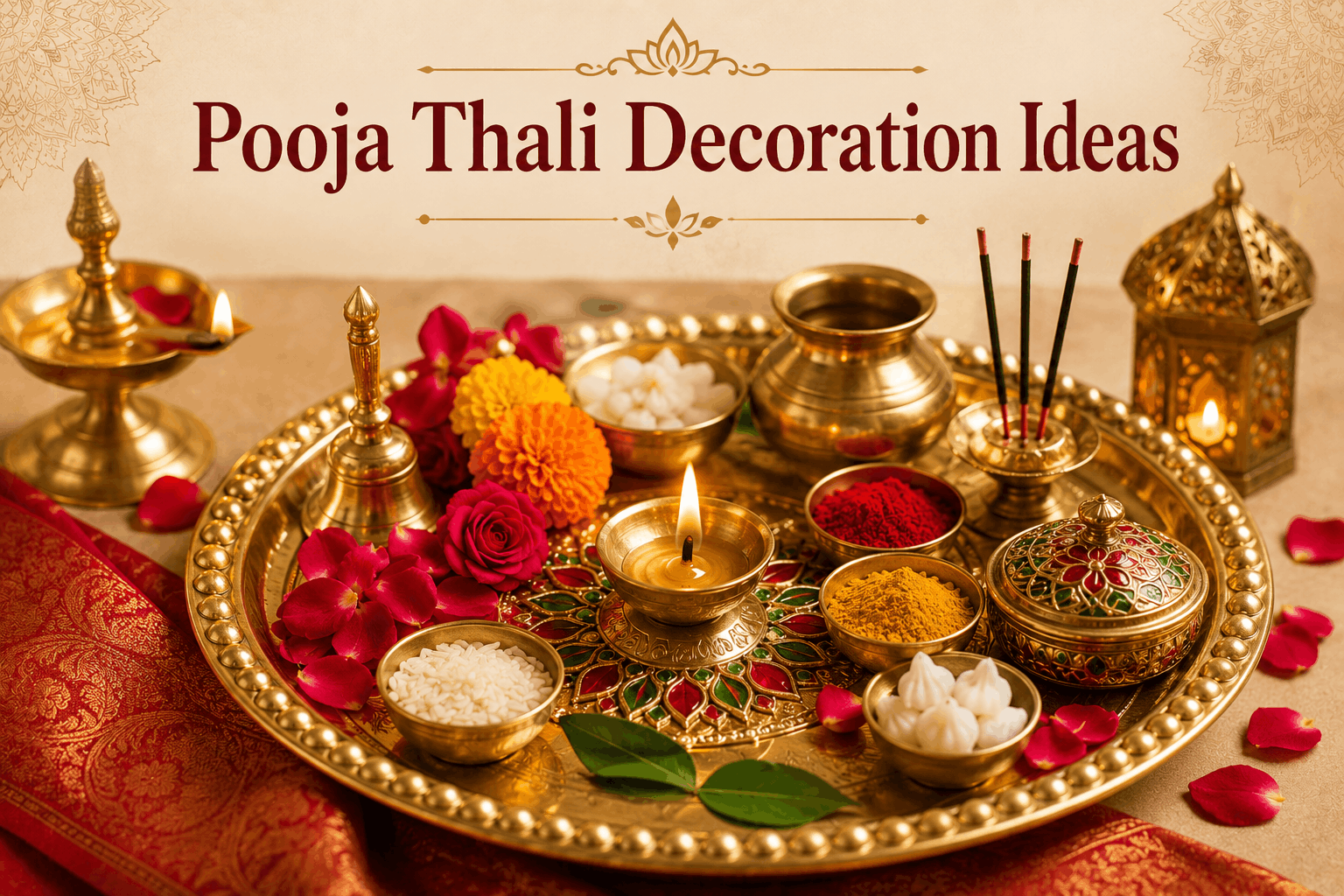
A complete pooja thali holds eleven things: a diya, kumkum, haldi, akshat (unbroken rice), chandan, flowers, dhoop or agarbatti, a kalash or lota of water, a ghanti (bell), naivedya (prasad) and a small spoon or achmani. Decorating it is simply a matter of arranging those eleven things with colour, symmetry and light — so the thali looks festive in photographs and still works properly when you are holding it during aarti.
Below is the full items list, ten decoration ideas you can actually do at home in fifteen minutes, an occasion-wise arrangement table, and the mistakes that make a beautiful thali impractical the moment the flame is lit.
⚡ Quick Answer
What goes on a complete pooja thali? Diya, kumkum, haldi, akshat, chandan, flowers, dhoop or agarbatti, a kalash or lota of water, a ghanti, naivedya and a small spoon. Arrange the diya in the centre, the small katoris of kumkum, haldi, chandan and akshat around the rim in a clockwise circle, and keep flowers and prasad on the outer edge. For decoration, work with one metal (brass or meenakari steel), one dominant colour, and let the diya be the only light source in the frame.
🪔 What Goes on a Complete Pooja Thali (Full Items List)
Every ritual has small regional variations, but these eleven items cover daily aarti and every major festival. Keep them in a good decorative pooja thali rather than a kitchen plate — the raised rim and diya holders are what stop wax, oil and kumkum from sliding around while you rotate the thali.
- Diya — The centre of the thali and the reason it exists. A brass or meenakari diya with a wide base stays steady during aarti; a two-wick or panch-mukhi diya is used for bigger pujas.
- Kumkum — Red vermilion for the tilak, kept in a small katori or a covered kumkum dabbi so it does not spill onto the flowers.
- Haldi — Turmeric, applied alongside kumkum. Traditionally kept to the left of the kumkum bowl.
- Akshat — Unbroken raw rice, often mixed with a pinch of haldi so it turns pale yellow. Broken grains are avoided — akshat literally means “unbroken”.
- Chandan — Sandalwood paste, used for the deity’s tilak. A small brass chandan wati keeps it moist through a long puja.
- Flowers — Loose petals or a few whole flowers. Marigold, rose and jasmine are the safest choices across deities; the flower is offered, so it should be fresh and unwilted.
- Dhoop or agarbatti — Incense, held in a dhoop dan or a small stand so the ash falls onto the thali and not the mandir shelf.
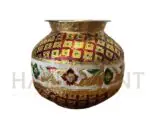
- Kalash or lota — A small vessel of clean water, sometimes with a mango leaf and a coconut for festival pujas. A meenakari kalash doubles as the most decorative object on the thali.
- Ghanti — The bell, rung at the start of the aarti. Keep it on the outer rim where your free hand can reach it.
- Naivedya — The prasad offering — a laddu, a piece of fruit, batasha or misri, placed on a small plate or leaf.
- Spoon or achmani — A tiny spoon for offering water. Easy to forget, and immediately missed mid-ritual.
If you are still building your setup from scratch, our guide on how to set up a home mandir covers direction, height and the order in which idols and thali should sit.
🎨 10 Pooja Thali Decoration Ideas You Can Do at Home
None of these need craft-shop supplies you do not already own. Pick one and stop — the most common decorating mistake is doing four ideas on the same thali.
1. Marigold ring with a centre diya — Line the rim with tightly packed marigold petals and place a single large brass diya dead centre. It photographs beautifully because the orange ring frames the flame. Fifteen minutes, zero cost if you already bought flowers.
2. Rangoli in rice and grains — Instead of petals, lay rajma, moong, masoor and rice in a spiral radiating from the centre. The earthy colour blocks look striking against a steel or meenakari base, and the grains can go straight into cooking afterwards.
3. Gota lace border — Stick a thin gold gota or zari lace around the outer rim with fabric glue. It survives multiple festivals, wipes clean, and turns a plain thali into a wedding-worthy one for under fifty rupees.
4. Diya cluster instead of one flame — Three or five small diyas in an arc rather than one large one. Odd numbers look intentional; even numbers look like something is missing. Best for Diwali, where more light is the whole point.
5. Colour-matched katoris — Use four identical small meenakari bowls for kumkum, haldi, chandan and akshat, all in the same colour family. Matching katoris do more visual work than any decoration you add on top.
6. Kalash as the hero — Move the diya slightly off-centre and let a decorated kalash — mango leaves, a coconut, a red thread around the neck — take the middle. This is the standard Navratri and Griha Pravesh arrangement.
7. Mirror and bead work — Small round mirrors glued around the rim catch the diya light and scatter it. Traditional in Gujarat and Rajasthan, and unbeatable for evening photographs.
8. Two-tone red and gold — Red cloth or red petals as the base layer, gold or brass objects on top. It is the single most reliable festive palette in India and it never looks cluttered.
9. Fresh leaf lining — Line the thali with banana or betel leaves before placing items. Costs almost nothing, looks completely traditional, and doubles as a clean surface for the prasad.
10. Themed thali for the occasion — Rakhi thali gets the rakhi, a small mithai plate and roli-chawal. Karva Chauth gets the chalni and a lota. A wedding thali gets the haldi, a diya and the ring plate. Match the objects to the ritual instead of adding generic decoration.
Most of these ideas rest on having a thali with good colour work to begin with. Our meenakari handicrafts range includes enamel thalis in green, pink and royal blue that need almost no added decoration — the hand-enamelled surface is the decoration.
📋 Occasion-Wise Pooja Thali Guide
The same thali works across the year; only the arrangement changes. Use this as a quick reference before each festival.
| Occasion | Thali Style | Must-Have Items | Decoration Approach |
|---|---|---|---|
| Daily aarti | Simple steel or brass, 8 inch | Diya, kumkum, akshat, agarbatti, ghanti | No decoration — prioritise a stable diya holder and easy cleaning |
| Diwali / Lakshmi Puja | Decorative meenakari, 10–12 inch | Multiple diyas, kalash, coins, batasha, kumkum | Diya cluster + marigold ring; red and gold palette |
| Navratri | Meenakari or mirror-work | Kalash with mango leaves, coconut, diya, red chunri | Kalash as the hero; garba-bright colours |
| Ganesh Chaturthi | Brass or wooden, 10 inch | Diya, modak as naivedya, durva grass, chandan | Green and red; durva laid in a fan around the diya |
| Karva Chauth | Decorative with a chalni | Chalni, lota of water, diya, mithai, sindoor | Gota lace border; red dominant, chalni decorated to match |
| Raksha Bandhan | Small, 8 inch, festive | Rakhi, roli, chawal, diya, mithai | Keep centre free for the rakhi; petals on the rim only |
| Wedding & Griha Pravesh | Large, 12 inch, ornate | Kalash, coconut, haldi, kumkum, diya, ring plate | Full gota work and mirror detail; this thali is on display for hours |
| Bulk return gifting | Meenakari, 6–8 inch | Thali + diya + small kalash as a set | Pre-boxed with a ribbon; keep every piece colour-matched |
🛕 How to Arrange the Thali (Order That Actually Works)
Decoration fails when the arrangement ignores how the thali is used. You hold it in one hand and rotate it clockwise while the other hand rings the ghanti — so weight distribution matters more than symmetry.
- Centre: the diya, always. It is the heaviest lit object and the balance point of the thali.
- Inner ring, clockwise: kumkum, haldi, chandan, akshat — in that order, in matching katoris. Muscle memory works better than hunting for a bowl mid-aarti.
- Outer rim: flowers, ghanti and the spoon, where your free hand naturally lands.
- Edge: naivedya and the kalash, so they can be lifted off without disturbing the centre.
- Weight check: if the kalash sits on one side, put the ghanti opposite it. An unbalanced thali tips towards the flame.
The thali also needs somewhere to rest between rituals. A pooja bajot or chowki at the right height keeps it off the floor, and our post on mandir decoration ideas for Indian homes covers how to lay out the shelf around it.
✨ Steel, Brass, Meenakari or Marble: Which Thali to Buy
Stainless steel — the practical daily-use option. It does not tarnish, wipes clean after oil spills, and costs the least. Best as your everyday aarti thali.
Brass — traditional, weighty and considered auspicious. It develops a patina and needs tamarind or lemon cleaning every few weeks, but it looks correct in a mandir in a way steel never quite does. Pairs naturally with brass idols for the home mandir.
Meenakari on a steel base — the best of both. A steel base that will not rust, with hand-enamelled colour work on top that makes decoration almost unnecessary. This is the format most commonly chosen for gifting and return gifts.
Marble — beautiful and heavy. Fine for a thali that stays on the mandir shelf, awkward for a thali you rotate during aarti, and prone to chipping if it is handled daily.
For gifting specifically, a thali reads as thoughtful rather than generic — which is why it appears so consistently in our wedding return gift ideas and Navratri return gift guides.
❌ Five Mistakes That Ruin a Decorated Thali
- Decoration that blocks the diya. Any lace, petal or paper within two inches of the flame is a fire risk and will singe by the third aarti.
- Too many colours. Three at most — usually red, gold and one accent. Beyond that the thali photographs as clutter.
- Loose kumkum and haldi. Always use covered katoris. Loose powder migrates into the flowers and ruins the look within minutes.
- Wilted flowers. Fresh petals or none at all. Yesterday’s marigold undoes every other effort on the thali.
- A thali too small for the occasion. An 8-inch thali cannot hold a kalash, coconut, multiple diyas and prasad. Keep a 12-inch one for festivals and weddings.
🧼 Cleaning and Storing Your Pooja Thali
- Wipe oil and wax off while the thali is still slightly warm — it lifts off far more easily than when set.
- For brass, use tamarind pulp or a lemon-and-salt rub, then dry immediately. Never leave brass wet.
- For meenakari, use only a soft damp cloth. Scrubbing powder strips the enamel colour permanently.
- Store festival thalis wrapped in a soft cloth, not stacked directly on other metal, to avoid scratching the enamel and the gold polish.
- Keep the small katoris in a separate pouch so they do not go missing between festivals.
❓ Frequently Asked Questions
1. What items are needed for a pooja thali?
A complete pooja thali needs eleven items: a diya, kumkum, haldi, akshat (unbroken rice), chandan, flowers, dhoop or agarbatti, a kalash or lota of water, a ghanti (bell), naivedya (prasad) and a small spoon for offering water.
2. How do you decorate a pooja thali at home?
Choose one idea rather than several. The simplest effective method is to line the rim with fresh marigold petals, place a single brass diya in the centre, and use four matching katoris for kumkum, haldi, chandan and akshat. Keep the palette to red and gold, and leave the area around the flame clear.
3. What is the correct order to arrange items on an aarti thali?
Place the diya in the centre. Arrange kumkum, haldi, chandan and akshat clockwise in an inner ring. Keep flowers, the ghanti and the spoon on the outer rim, and the kalash and naivedya at the edge so they can be lifted off without disturbing the centre.
4. Which pooja thali is best — steel, brass or meenakari?
Steel is best for daily use because it does not tarnish. Brass is the traditional choice and looks most appropriate in a mandir but needs regular cleaning. Meenakari on a steel base is best for festivals and gifting, since the enamel work provides the decoration and the steel base does not rust.
5. What size pooja thali should I buy?
An 8-inch thali is right for daily aarti and personal use. Choose 10 to 12 inches for festivals, weddings and Griha Pravesh, where you need room for a kalash, coconut, multiple diyas and prasad.
6. Can a pooja thali be given as a gift?
Yes. A pooja thali is one of the most widely accepted gifts in India because it is auspicious and genuinely used. It is a standard choice for weddings, housewarmings, Diwali and Navratri return gifts, and works especially well paired with a small kalash or a dry fruit box as a set.
7. Do you supply pooja thalis in bulk for weddings and events?
Yes. As a direct manufacturer in Jasdan, Gujarat, we supply pooja thalis, diyas and kalash sets for bulk, wedding and corporate orders, with custom colours and quantities on request. Contact us on WhatsApp for wholesale pricing and customisation.
🪔 Build Your Complete Pooja Thali with Hanumant Handicraft
From decorative pooja thalis and meenakari kalash sets to complete gift collections and the wider meenakari handicrafts range — we craft every piece by hand at our workshop in Jasdan, Gujarat, and sell direct at honest factory prices.
🚚 Free shipping on orders over ₹399 • 🏭 Direct manufacturer — best factory prices • 📦 Wholesale & bulk orders welcome