
Gifts You Should Not Give: Inauspicious Gift Items to Avoid in India (2026 Guide)

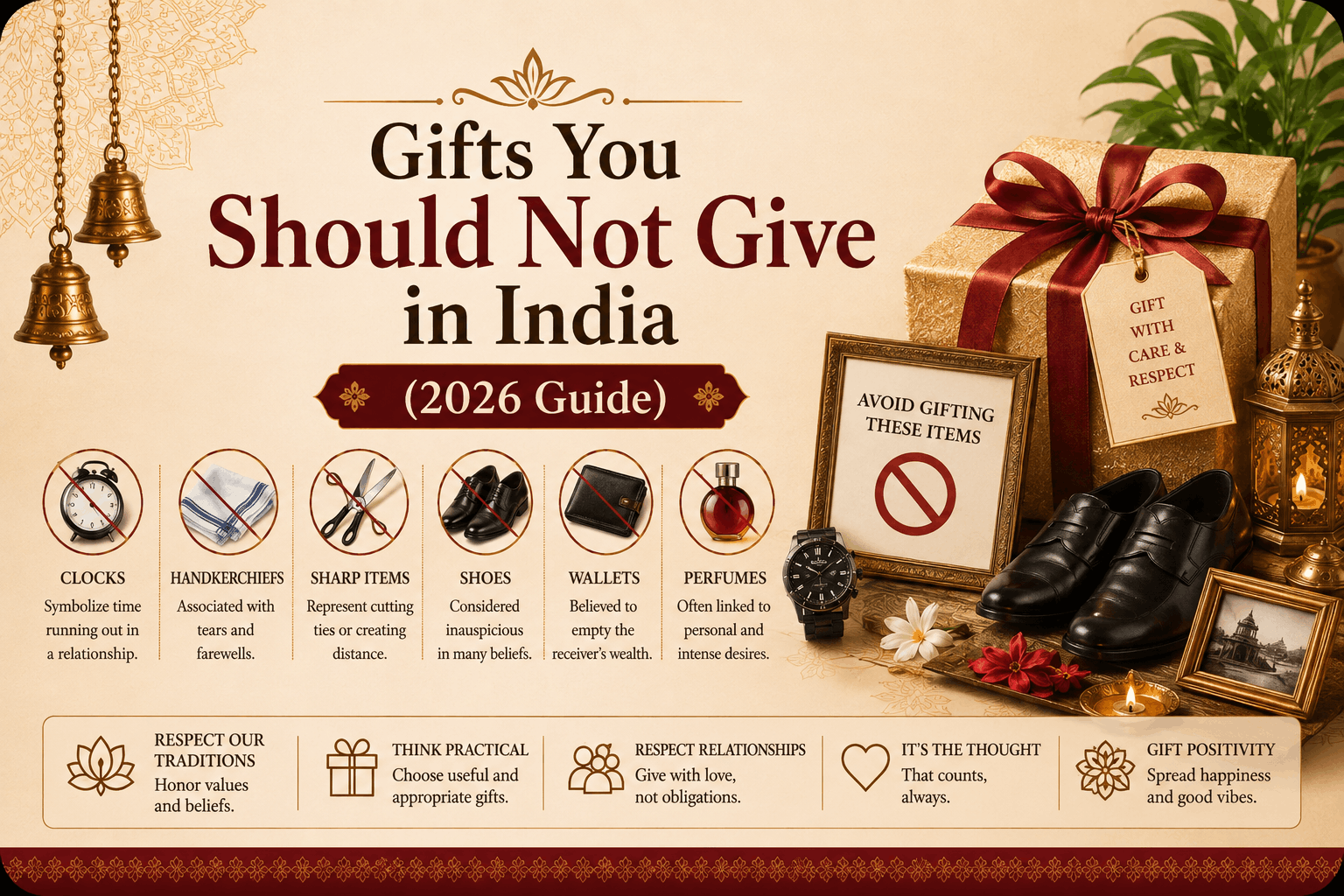
Quick answer: In Indian culture, the gifts you should not give include sharp objects like knives and scissors, black-coloured items, handkerchiefs, footwear, clocks, leather goods, empty wallets, iron articles, and anything chipped or broken. Each is linked to a belief about cutting ties, tears, bad luck, or impurity. The safe route is to gift something auspicious and handmade instead — a meenakari dry-fruit box, a pooja thali, or a brass idol with a proper singhasan.
Most people put a lot of thought into what to buy and almost none into what to avoid. And in India, that second list matters just as much. A gift here is not only a present — it carries shagun, intention, and a quiet message about the relationship. Hand over the wrong thing at a wedding or a griha pravesh and, however expensive it was, someone in the family will notice. This guide covers the gifts you should not give, the reasoning behind each belief, and what to give instead so your gift lands the way you meant it to.
🚫 Why Some Gifts Are Considered Inauspicious
The logic behind these customs is fairly consistent once you see the pattern.
1. Symbolism travels with the object. Anything that cuts, ends, or wipes away carries that meaning into the relationship — which is why sharp items and handkerchiefs are avoided.
2. Colour and metal carry energy. Black and plain iron are tied to Shani and mourning; brass, copper, silver, red and gold are considered shubh and are used across pooja and gifting traditions.
3. Completeness matters. Empty, chipped, cracked, or repaired items are seen as gifting incompleteness — which is why an empty purse always gets a coin tucked inside.
4. Faith and diet are personal. Leather, alcohol, and non-vegetarian hampers can quietly offend Jain, vegetarian, and many Hindu households, regardless of price.
5. Function outlives the occasion. A gift that gets used every day keeps the goodwill alive; a gift that gets hidden in a cupboard says the opposite.
❌ Gifts You Should Not Give — and What to Give Instead
Here is the complete list at a glance, with a safer handcrafted swap for each.
| Gift to Avoid | Why It Is Avoided | Give This Instead |
| Knives, scissors, sharp tools | Believed to “cut” the bond between giver and receiver | Meenakari steel dabba |
| Black-coloured items | Colour of mourning and Shani; inauspicious for shubh occasions | Red, green & gold meenakari pieces |
| Handkerchiefs & towels | Associated with wiping tears and with farewells | Decorative key holder |
| Footwear | Suggests the person walking away; considered impure to gift | Handcrafted gift items |
| Clocks & watches | Read as counting down time; avoided at weddings and griha pravesh | Pooja thali set |
| Leather wallets, belts, bags | Animal-hide products offend many vegetarian and Jain families | Jewellery & bangle box |
| Empty wallets or purses | Gifting emptiness invites scarcity — never hand one over bare | Same gift with a ₹1 or ₹11 coin inside |
| Plain iron or dark metal articles | Iron is linked to Shani and considered inauspicious for gifting | Brass idols under ₹1000 |
| Chipped, cracked or repaired items | Damage is inauspicious; also reads as careless | A new, factory-fresh handcrafted piece |
| Nataraja idols, war art, tomb replicas | Vastu advises against intense or funerary imagery at home | Home mandir & temple |
| White & funeral flowers | Chrysanthemums and white lilies are used for last rites | Meenakari kalash |
| Alcohol & non-veg hampers | Risky for religious, teetotal and vegetarian households | Dry-fruit gift box |
| Cash in round figures | Even, divisible amounts are considered an ending, not a beginning | ₹101, ₹501, ₹1,100 — always with the extra ₹1 |
| Cactus & thorny plants | Thorns are believed to bring friction into the home | Pooja bajot or chowki |
🔪 The Big Ones, Explained
A few of these come up again and again — worth understanding rather than just memorising.
1. Sharp objects. Knife sets are a very common housewarming mistake because they look practical and premium. In Indian belief, anything with a blade symbolically severs the relationship. If someone genuinely wants a knife set, the traditional workaround is to let them “buy” it from you for a token ₹1.
2. Clocks and watches. A watch is a lovely personal gift in most of the world, but at Indian weddings and griha pravesh it is increasingly avoided — the imagery of time running out sits badly against a fresh beginning. Save it for birthdays and farewells within close family.
3. Leather. This one is less superstition and more respect. A leather wallet in a Jain or strictly vegetarian home is not a small misstep, and you rarely get told about it. When in doubt, gift wood, brass, steel, or fabric.
4. Handkerchiefs. Small, cheap, and loaded with the wrong meaning — tears and goodbyes. The same applies to gifting towels on their own at auspicious functions.
5. Anything empty. Purses, wallets, jewellery boxes, and containers should never be handed over bare. Slip in a coin, a few dry fruits, or a small sweet so the gift represents abundance rather than a void.
6. Damaged goods. Even a hairline chip on a brass idol or a dented box is enough to make the gift inauspicious. Always inspect a handcrafted item before wrapping — clean enamel, no cracks, tight-fitting lids.
💰 The Shagun Rule: Why It Is Always ₹101, Never ₹100
Cash is perfectly acceptable in Indian gifting — the amount just needs to be right. The extra ₹1 makes the number indivisible, symbolising continuity and growth rather than a clean end.
| Avoid Giving | Give This Instead | Typical Occasion |
| ₹100 | ₹101 | Small shagun, children, staff |
| ₹500 | ₹501 | Return gift envelope, close friends |
| ₹1,000 | ₹1,001 or ₹1,100 | Weddings, engagements |
| ₹2,000 | ₹2,100 | Close family weddings |
| ₹5,000 | ₹5,001 or ₹5,100 | Immediate family, major functions |
The same thinking applies to gift sets — an odd, deliberate pairing feels more considered than a flat, round bundle. Our guide to handcrafted gifts under ₹1000 covers how to build combos that look generous without overspending.
🎊 Occasion-Wise Mistakes to Avoid
The same gift can be perfect at one function and awkward at another.
1. Weddings and shaadi. Skip black clothing, sharp objects, and single-piece decor that clashes with a new home. A Gujarati wedding item set or a filled dry-fruit box is the traditional, never-wrong choice.
2. Housewarming / Griha Pravesh. The three classic errors are a knife set, a wall clock, and artwork showing war, sinking ships, or lone animals. Give something auspicious for the new home instead — see our housewarming gifts under ₹1000 picks.
3. Diwali and festivals. Avoid leather goods, alcohol, and dark or plain black packaging. Festive gifting should look bright — meenakari boxes, thalis, and Lakshmi-Ganesh idols carry the right energy.
4. Godh bharai and baby functions. No sharp items, no black, and nothing second-hand. Small brass or silver-finish pieces are the safe traditional gift.
5. Return gifts at large functions. Fragile glass is a double mistake — breakage is inauspicious and impractical across two hundred guests. Durable meenakari steel boxes work far better; our return gifts under ₹200 guide has bulk-friendly options.
6. Corporate gifting. Avoid alcohol, leather, and religious idols across a mixed-faith team. A neutral, premium serving tray and glass set or dry-fruit box suits everyone on the list.
🕉️ Gifting Idols and Pooja Items: The Do’s and Don’ts
Pooja items make beautiful gifts, but there are a few rules worth respecting.
1. Never gift a chipped or hollow idol. Damage on a murti is considered strongly inauspicious. Solid brass with clean detailing is the standard to look for.
2. Avoid duplicating a deity. Many families keep a single idol of a deity in the home mandir, so a second Ganesha can be awkward. A singhasan, bed or jhula for the idol they already have is the safer, more useful gift.
3. Skip intense forms for a home. Nataraja and fierce or battle depictions are generally kept out of homes; calm, seated forms are preferred for the mandir.
4. Do not gift used pooja articles. Anything already used in worship stays with that household. Gift new pieces only.
5. Gift the setup, not just the murti. A pooja thali, kalash, or bajot is always welcome and never conflicts with what they already own — our pooja thali decoration guide shows what a complete thali includes.
✅ Safe Gifts That Never Go Wrong
If you want to stop second-guessing, these categories are safe across almost every Indian occasion and household:
- Meenakari dry-fruit boxes — festive, filled, and universally appreciated
- Decorative pooja thalis — auspicious and genuinely used
- Brass idols with a proper asan — meaningful for weddings and new homes
- Jewellery and bangle boxes — personal without being intrusive
- Meenakari steel containers — durable, colourful, ideal in bulk
- Serving trays and glass sets — a generous-looking housewarming standard
Buying from a direct manufacturer in Jasdan, Gujarat also means you can inspect finish and quality properly — the surest way to avoid gifting something chipped or poorly made. Browse the full collections to compare.
❓ Frequently Asked Questions
1. Which gifts are considered inauspicious in India?
Sharp objects such as knives and scissors, black-coloured items, handkerchiefs, footwear, clocks and watches, leather goods, empty wallets, plain iron articles, and anything chipped or broken are all considered inauspicious gifts in Indian culture.
2. Why should you not gift knives or scissors?
Anything with a blade is believed to symbolically cut the bond between the giver and the receiver. If a knife set is genuinely wanted, the traditional workaround is for the receiver to hand over a token ₹1 so it counts as a purchase rather than a gift.
3. Is it wrong to gift a clock or watch in India?
Clocks and watches are avoided at weddings and housewarmings because they suggest time running out, which clashes with a new beginning. They are generally fine for birthdays and farewells within close family.
4. Can I gift leather items like wallets or belts?
It is best avoided unless you know the household well. Leather is made from animal hide and is unwelcome in many Jain, vegetarian and Hindu homes. Wood, brass, steel or fabric gifts are safer alternatives.
5. Why do people give ₹101 instead of ₹100?
The extra ₹1 makes the amount indivisible, which symbolises continuity and growth rather than a clean ending. The same rule applies at every level, so ₹501 and ₹1,100 are preferred over ₹500 and ₹1,000.
6. Is it okay to gift a God idol to someone?
Yes, provided the idol is new, undamaged and in a calm seated form. Avoid gifting a deity the family already keeps in their mandir, and avoid used pooja articles. A singhasan, bajot or pooja thali is a safe alternative that never conflicts with what they own.
7. What is the safest gift for an Indian wedding or housewarming?
A filled meenakari dry-fruit box, a decorative pooja thali, or a brass idol with a proper singhasan. All three are auspicious, useful, and appropriate across regions, budgets and family traditions.
🎁 Gift Right, Every Time — With Hanumant Handicraft
From meenakari dry-fruit boxes, pooja thalis, and jewellery boxes to complete gift collections — we craft auspicious, handmade gifts for weddings, festivals and housewarmings, direct from our workshop in Jasdan, Gujarat, at honest factory prices. Need help choosing for a specific occasion or a bulk order? Talk to us on WhatsApp or contact us here.
🚚 Free shipping on orders over ₹399 • 🏭 Direct manufacturer — best factory prices • 📦 Wholesale & bulk orders welcome