
Bulk Handicraft Suppliers in India: A Buyer’s Guide to MOQ, Lead Times & Customization

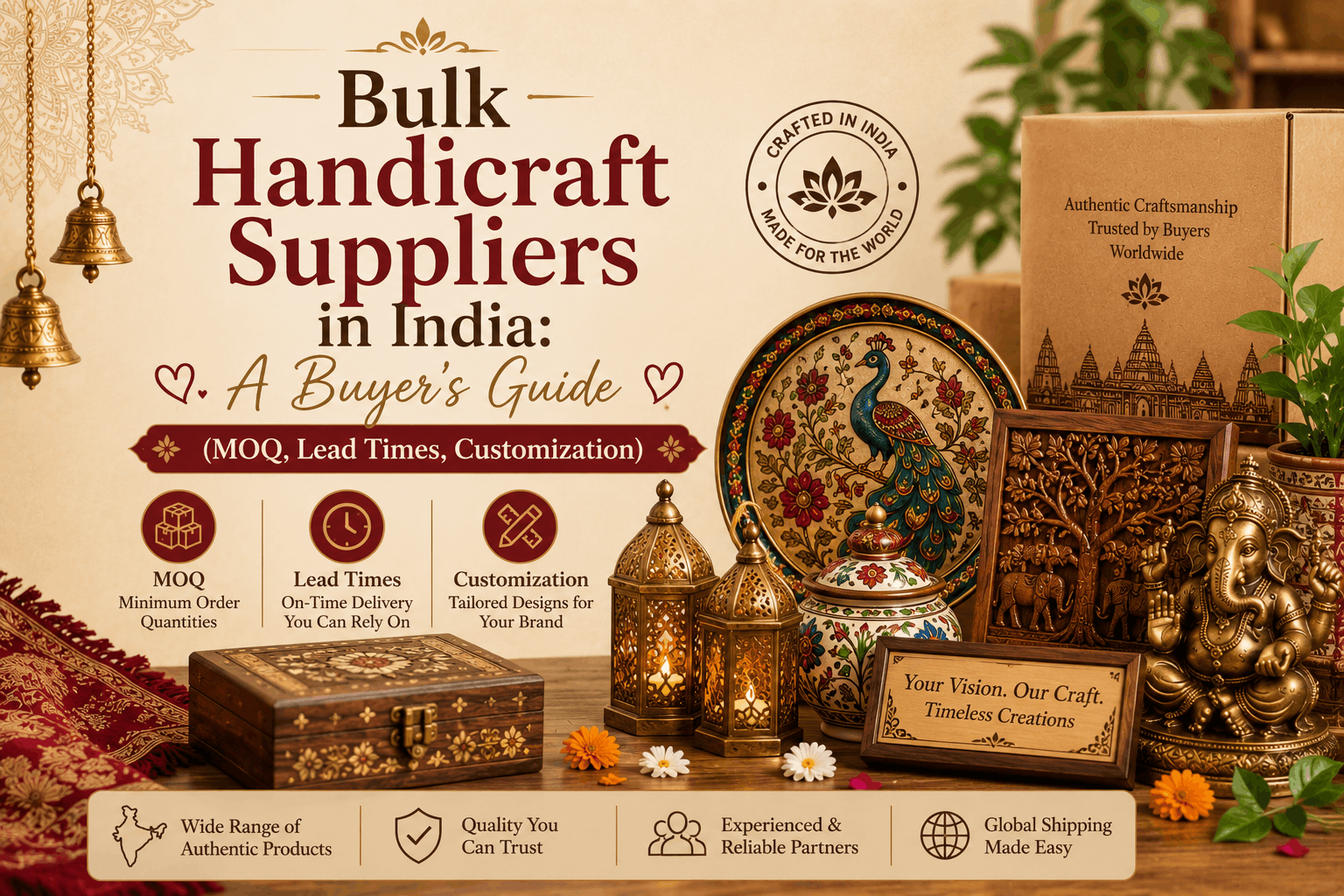
Quick answer: To source handicrafts in bulk from India, work directly with a manufacturer rather than a reseller, confirm the minimum order quantity (MOQ) before you fall in love with a product, build 4–8 weeks of lead time into your plan (longer near festivals), and lock customization details — material, finish, logo, packaging — in writing before you pay an advance. The four things that decide whether a bulk order goes smoothly are MOQ, lead time, customization scope, and the supplier’s quality-control process.
Buying handicrafts one or two at a time is easy. Buying 500 brass diyas, 1,000 meenakari coasters, or 250 corporate gift hampers — on a deadline, to a price, with your logo on them — is a different exercise entirely. This guide walks through what actually matters when you place a bulk order, so you can ask the right questions and avoid the expensive surprises.
🏭 Why Buyers Source Handicrafts in Bulk from India
India remains the obvious place to source handcrafted goods at scale, and not only because of price. The country has clusters of generational craft skill that are hard to replicate elsewhere — brass and metalware, meenakari enamel work, hand-carved wood, marble, blue pottery, jute and textiles all have their own regional homes. For a bulk buyer that translates into three practical advantages: a deep supplier base, genuine customization ability, and competitive unit costs even at modest volumes.
The flip side is fragmentation. Quality, reliability and communication vary enormously between one workshop and the next, which is exactly why a structured sourcing process pays off.
🗺️ Where India’s Handicraft Hubs Are
Knowing the cluster helps you find the right supplier and judge whether a quoted price is realistic. A few of the well-known centres:
- Brass and metalware — Rajkot and Jasdan in Gujarat, plus Moradabad in Uttar Pradesh. This is where most pooja items, idols, diyas and brass gifting lines originate.
- Meenakari and enamel work — Jaipur is the traditional home, though manufacturers across Gujarat and Rajasthan now produce it at scale.
- Wood carving — Saharanpur (UP) and Channapatna (Karnataka) for carved and lacquered wood.
- Marble and stone — Makrana and Jaipur in Rajasthan.
- Blue pottery and ceramics — Jaipur and Khurja.
If a supplier sits inside the relevant cluster, you’re usually buying closer to the source — better pricing and tighter quality control than going through a trader two cities away.
📦 Understanding MOQ (Minimum Order Quantity)
MOQ is the smallest quantity a supplier will produce or sell in one order. It’s the single most common point of confusion in bulk sourcing, so it’s worth getting clear early.
Why MOQs exist: Handcrafted production has fixed setup costs — preparing moulds or dies, mixing a specific enamel colour, calibrating a finish, arranging a custom box. A supplier needs a minimum run to make that setup worthwhile.
What’s typical: There’s no universal number. For standard, ready-pattern items an MOQ might be as low as 25–50 pieces. For a customized product — your logo engraved, a non-standard size, a bespoke colour — expect the MOQ to climb, because the setup applies to the whole batch.
How to handle it:
- Ask for the MOQ per design, not per order. Mixing five designs at 20 pieces each is often treated differently from 100 of one design.
- If your volume is below MOQ, ask whether the supplier holds stock of a standard version you can buy off the shelf.
- Negotiate, but expect a higher per-unit price below MOQ rather than a flat refusal. That trade-off is normal and fair.
⏱️ Lead Times: What’s Realistic
Lead time is the gap between confirming your order (usually with an advance) and the goods being ready to ship. Underestimating it is the most common reason bulk gifting projects miss their deadline. A reasonable rule of thumb:
- Standard items, in-stock or simple finish: roughly 1–3 weeks.
- Customized items (logo, special finish, custom packaging): roughly 4–8 weeks.
- Large or complex orders: 8 weeks and up.
Three things stretch lead times. First, the festive calendar — workshops are heavily booked from roughly August through Diwali, so a job that takes four weeks in June can take seven in September. Second, customization rounds — every sample approval cycle adds days. Third, logistics — domestic dispatch is quick, but export shipping, customs and documentation add their own window.
The practical move: work backwards from your delivery date, add a buffer, and confirm the supplier’s quoted lead time in writing before you commit. If you’re planning a corporate Diwali or wedding-season order, our note on corporate gifting trends for 2026 explains why September is already late to start.
🎨 Customization and Branding
This is where a real manufacturer earns its keep. The customization options worth asking about:
- Logo and personalization — engraving, embossing, screen printing or laser marking on brass and metal; printing or foiling on packaging. Confirm the method, the placement, and whether there’s a one-time setup charge.
- Material and finish — the same idol or diya can come in different finishes (antique, polished, matte, gold-tone). Lock the finish to an approved sample so there’s no ambiguity.
- Size and design changes — most workshops can scale a design up or down, but it affects mould costs and MOQ.
- Custom packaging — branded boxes, inserts, gift sleeves and hampers. For gifting orders, packaging often matters as much as the product itself.
- Private label — supplying under your own brand, with no manufacturer marks.
Always approve a physical pre-production sample before the full run starts. A photo is not enough for handcrafted goods — colour and finish read differently in person, and a paid sample is far cheaper than rejecting a batch of 1,000. For an idea of which products customize well for gifting at scale, see our breakdown of meenakari handicraft items for gifting.
💰 What Drives the Price
Bulk pricing isn’t only about quantity. The main levers:
- Material — pure brass costs more than brass-plated; ashtadhatu more than brass; solid wood more than composite.
- Volume — unit cost drops as quantity rises, which is the whole point of buying in bulk.
- Labour and detail — hand-painted meenakari or fine carving carries more labour cost than a plain cast piece.
- Customization — setup charges and bespoke packaging add to the per-unit price, especially at lower volumes.
- Finish and quality grade — a higher polish or premium finish costs more.
A quote that looks dramatically cheaper than others usually means a different material grade or a thinner gauge of metal. Ask what’s behind the number rather than assuming you’ve found a bargain.
✅ Packaging, Quality Control and Export
For any serious bulk order, ask the supplier two direct questions: what is your quality-check process before dispatch, and how are the goods packed for transit. Handcrafted items — especially brass, ceramic and glass — are vulnerable in transit, and good suppliers pack accordingly.
If you’re buying from outside India, factor in export documentation, customs duties at the destination, and realistic shipping windows. Our guide to bulk gifting for NRI weddings covers the shipping and customs side in more detail, and the same principles apply to commercial export orders. The dry fruit box sourcing guide is a useful companion if your order combines handicrafts with packaged gifting.
🔍 Payment Terms and Vetting a Supplier
Standard practice for bulk handcrafted orders is a part advance (commonly 30–50%) to confirm and start production, with the balance before dispatch. Treat anyone demanding full payment up front with caution, and anyone offering no advance terms at all with equal caution — both are unusual.
A quick supplier-vetting checklist before you commit:
- Are they a manufacturer or a reseller? A manufacturer controls quality, price and customization directly. A reseller adds a margin and a layer of distance.
- Will they send a paid sample? Willingness to produce a pre-production sample is a strong signal.
- Is the MOQ, lead time, finish and price in writing? Verbal quotes drift.
- Can they show past bulk or corporate work? Evidence of similar-scale orders matters more than a catalogue.
- How do they communicate? Slow or vague replies before you’ve paid rarely improve after you have.
🤝 Why Buy Directly from a Manufacturer
The single biggest decision in bulk sourcing is whether you buy from the workshop that makes the product or from someone reselling it. Buying direct means better pricing (no middleman margin), real customization (the people changing the product are the people you’re talking to), and accountability (one party owns the quality).
Hanumant Handicraft is a Jasdan, Gujarat–based manufacturer producing brass, meenakari and pooja handicrafts for bulk, corporate and gifting orders — with in-house customization, branded packaging, and direct quotes on MOQ and lead time. If you’re planning a bulk or corporate order, that’s the kind of partner worth shortlisting. For smaller per-unit budgets, our return gifts under ₹500 for bulk orders and housewarming gifts under ₹1000 give a sense of what’s possible at volume.
❓ Frequently Asked Questions
What is the minimum order quantity for bulk handicrafts in India?
There’s no fixed number — it depends on the product and the level of customization. Standard ready-pattern items can start around 25–50 pieces, while customized items (logo, special finish, bespoke packaging) usually carry a higher MOQ because the setup cost applies to the whole batch. Always ask for the MOQ per design rather than per order.
How long does a bulk handicraft order take to deliver?
Standard or in-stock items typically take 1–3 weeks, customized items 4–8 weeks, and large or complex orders longer. Lead times stretch during the festive season (August to Diwali), so confirm the timeline in writing and build in a buffer when working to a deadline.
Can handicraft suppliers add my company logo?
Yes. Most manufacturers offer engraving, embossing, printing or laser marking on products, and branded printing on packaging. Confirm the method, placement and any one-time setup charge, and approve a physical sample before the full run.
Is it cheaper to buy from a manufacturer or a reseller?
Buying directly from a manufacturer is usually cheaper and more flexible, because there’s no middleman margin and the people making the product are the ones handling your customization and quality control.
What payment terms are normal for bulk handicraft orders?
A part advance of around 30–50% to confirm and begin production, with the balance paid before dispatch, is standard. Be cautious of suppliers demanding full payment up front.
Where are the main handicraft manufacturing hubs in India?
Major centres include Rajkot and Jasdan (Gujarat) and Moradabad (UP) for brass and metalware, Jaipur for meenakari and blue pottery, Saharanpur and Channapatna for wood, and Makrana and Jaipur for marble and stone.