

Bulk Gifting for NRI Weddings: Shipping, Customs & Packaging Tips

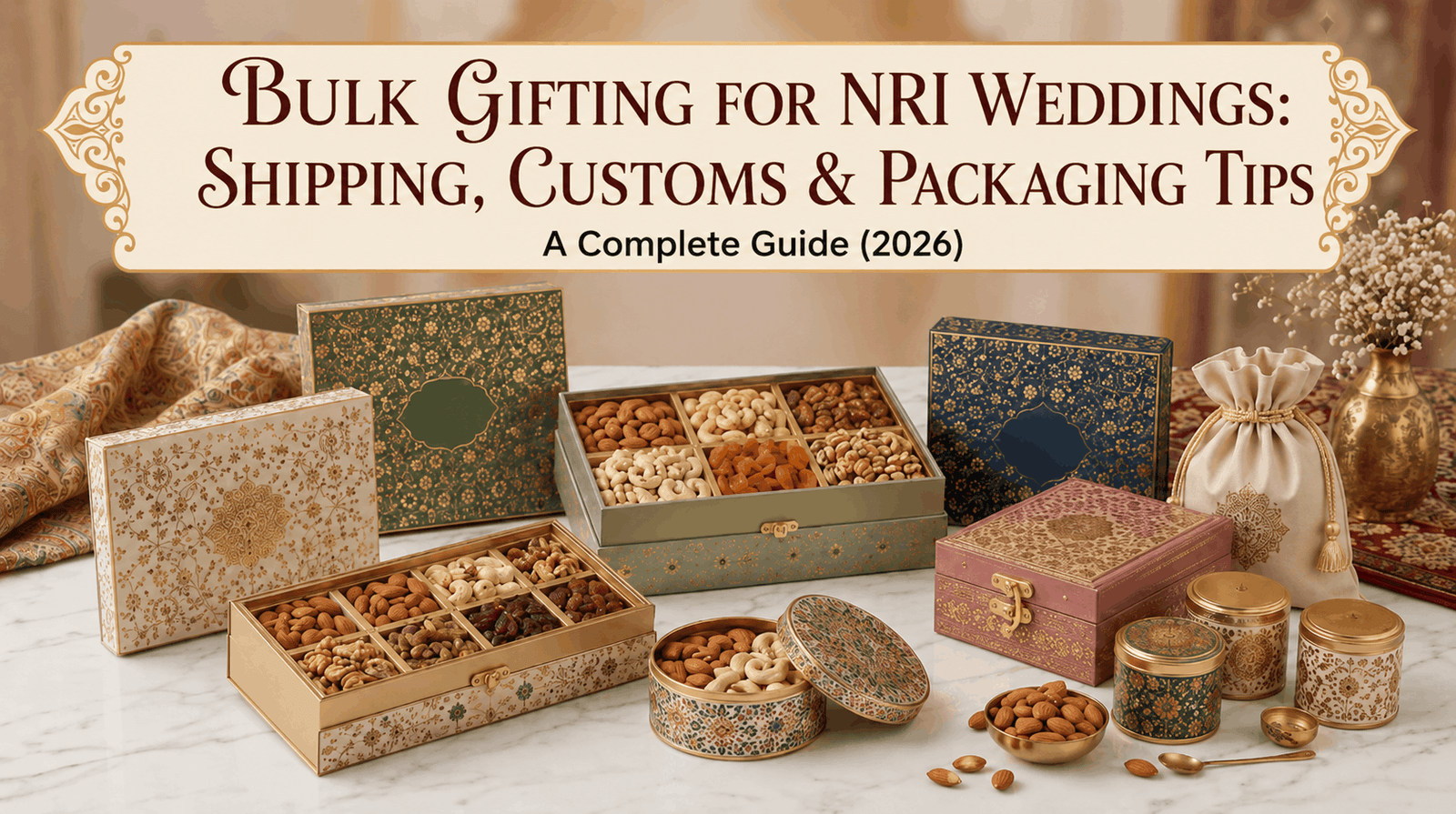
A practical playbook for families and event planners sending handcrafted Indian wedding gifts overseas — without the breakage, the customs surprises, or the last-minute panic.
NRI weddings come with a familiar headache. The shagun is decided in India, the function is in New Jersey or London or Melbourne, and somewhere between the two, fifty to two hundred return gifts need to arrive — intact, on time, and without the host getting a surprise customs bill at the door.
This guide is for anyone planning that journey. Whether you’re sending meenakari dry fruit boxes, pooja thalis, or full Gujarati wedding sets abroad, the logistics are the same. Get them right once, and the rest of the planning gets easier.
✈️ Why NRI Wedding Gifting Needs a Different Playbook
Domestic gifting in India is forgiving. A courier delay of two days, a slightly dented box, a missing piece — all fixable. International shipping is not. Once a consignment leaves Mumbai or Delhi, you are working with three variables you can’t easily control: the airline, the destination country’s customs, and the recipient’s local last-mile delivery.
The good news: every part of this is manageable if you plan early and pack smart. Most NRI bulk gifting problems trace back to one of four mistakes — wrong courier choice, under-declared invoices, poor cushioning, or missing the wedding date by ordering too late.
📦 Choose Your Shipping Method First, Not Last
Before you finalise the gifts, decide how they’re getting there. The shipping method dictates your weight budget, your packaging style, and your timeline.
| Shipping Mode | Transit Time | Best For | Approx. Cost (per kg) | Reliability |
|---|---|---|---|---|
| Air Courier (DHL, FedEx, Aramex) | 4–8 days | Up to 50 gift sets, urgent orders | ₹900–₹1,800 | Very high |
| India Post International EMS | 10–18 days | Small batches, budget-conscious | ₹500–₹900 | Moderate |
| Air Cargo (Freight Forwarder) | 7–14 days | 50–300 sets, mid-volume weddings | ₹400–₹700 | High |
| Sea Freight (LCL/FCL) | 30–55 days | 300+ sets, planned 3+ months ahead | ₹80–₹200 | High (slow) |
Air courier is the default for most NRI families because it’s predictable and door-to-door. But if you’re shipping 100+ heavier items like brass pooja chowkis or God singhasans, sea freight can cut your shipping cost by 70% — provided you order three months before the wedding.
A rule of thumb: under 30 kg total, use express courier. 30–150 kg, talk to a Mumbai or Ahmedabad-based freight forwarder. Above 150 kg, sea freight starts to make sense.
🛃 Understanding Customs in the Top NRI Destinations
This is where most first-time senders get caught off guard. Customs duty is decided by the destination country, not India. And duty-free thresholds vary wildly.
| Country | Duty-Free Threshold (Gifts) | Typical Duty Above Threshold | Notes |
|---|---|---|---|
| USA | USD 800 per shipment | 0–7% (handicrafts often exempt under HTS 9601–9602) | Mark as “personal gift, no commercial value” if applicable |
| UK | GBP 39 per recipient | 20% VAT + 2.5% duty above GBP 135 | Each recipient parcel is assessed separately |
| Canada | CAD 60 per gift | 5% GST + provincial tax | Wedding gifts often released on goodwill if labelled clearly |
| Australia | AUD 1,000 per shipment | 10% GST + 5% duty | Must declare wooden items for biosecurity |
| UAE | AED 1,000 personal use | 5% VAT above threshold | Religious items usually clear smoothly |
| Singapore | SGD 400 | 9% GST | Strict on undervalued declarations |
| New Zealand | NZD 1,000 | 15% GST + duty | Wood, seeds, organic material flagged |
Three things to remember:
Declare honestly. Under-declaring to dodge duty is the single biggest reason shipments get held, opened, and delayed. Customs officers in the US, UK, and Australia routinely flag invoices that look unrealistic for the volume.
Split shipments where possible. If you’re sending 80 return gifts to one family in the UK, the entire shipment is taxed as a single import. If those 80 gifts are addressed to 80 individual recipients via a fulfilment service, each parcel falls under the personal gift threshold. The math changes completely.
Wood declarations matter. Australia, New Zealand, and parts of the US are strict about untreated wood. If you’re shipping wooden bajots or jewellery boxes, ask your manufacturer for a heat-treatment or ISPM-15 certificate. It’s a small paperwork addition that prevents the entire consignment being quarantined.
📐 Packaging That Actually Survives the Journey
A meenakari piece that travels 12,000 km through three sorting hubs is going to get tossed, stacked, and dropped at least a dozen times. Standard retail packaging won’t survive. Here’s what works.
The Three-Layer Rule
Every fragile gift needs three layers of protection:
The inner layer wraps the item itself — bubble wrap or tissue paper, taped snug, no movement when shaken. The middle layer is the gift box (the one the recipient actually sees) — keep this clean, undamaged, with the brand identity intact. The outer layer is the shipping carton — corrugated, double-walled, sized so each gift box has 2–3 cm of foam, peanuts, or air-pillow buffer on every side.
If you can shake the outer carton and hear anything move inside, it will arrive broken. Reopen and re-pad.
Material Choices by Gift Type
| Gift Type | Inner Packing | Outer Carton | Special Care |
|---|---|---|---|
| Meenakari dry fruit boxes | Bubble wrap + tissue | 5-ply corrugated | Tape compartments shut to stop rattling |
| Pooja thali sets | Foam sheet between plates | 5-ply with dividers | Wrap diyas separately |
| Brass or metal chowkis | Bubble wrap, double layer | 7-ply heavy-duty | Heavy items go bottom of carton |
| Wooden bajots | Edge protectors + foam | 5-ply | Fumigation certificate for some countries |
| Glass items (kalash, lota) | Thick bubble wrap + foam shell | 7-ply, “FRAGILE” marked | Mark “THIS SIDE UP” |
| Serving tray & glass sets | Individual sleeves + tray-shaped foam | Custom-fit carton | Trays separated by cardboard |
Aesthetic vs. Shipping Packaging — Keep Them Separate
A mistake families often make: they pack the beautiful gold-foiled gift box directly into the shipping carton and assume that’s enough. By the time it reaches the recipient, the gold foil is scuffed, the ribbon is crushed, and the unboxing moment is gone.
Always pack the presentation box inside a plain protective shell — a polybag, butter paper wrap, or thin cardboard sleeve — before it goes into the shipping carton. This way the recipient pulls out a pristine gift, not a beaten-up one.
📅 Timeline: When to Start Each Step
NRI weddings have one universal truth — somebody always realises three weeks before the function that the gifts haven’t been ordered. Don’t be that person.
| Weeks Before Wedding | What to Do |
|---|---|
| 12–16 weeks | Finalise gift selection, get samples, lock manufacturer |
| 10–12 weeks | Confirm count, customise (monograms, tags, packaging) |
| 8–10 weeks | Production starts; finalise shipping method |
| 6–8 weeks | Shipping booked; documentation prepared |
| 4–6 weeks | Air courier dispatch (if air); sea freight should already be sailing |
| 3–4 weeks | Track shipment, prepare customs paperwork |
| 2 weeks | Confirm delivery to host; backup small reorder if needed |
| 1 week | Final inspection, sort by event (haldi, sangeet, reception) |
If you’re working with a manufacturer like us in Jasdan, Gujarat, bulk production on customised orders typically needs 3–4 weeks. Add a week for quality check and packing, then your shipping window on top. That’s why the 12–16 week start is realistic, not paranoid.
📄 Documentation You’ll Need
For any international shipment, keep these ready before booking the courier:
A commercial invoice listing each item with HSN code, quantity, unit value, and total. Handicrafts generally fall under HSN 9601–9602 or 4420 (wooden articles). A packing list showing carton-wise contents and weights. A KYC document for the sender — Aadhaar or PAN. The recipient’s full address with mobile number and a valid local ID where required (especially for UAE and Saudi Arabia).
For wooden items going to Australia, New Zealand, USA, EU, or the UK, ask your manufacturer for an ISPM-15 compliance note or a heat-treatment declaration. It’s the single piece of paper that prevents quarantine.
💰 Cost Estimation: A Realistic Example
Let’s say you’re sending 100 mid-range return gifts — meenakari dry fruit boxes at ₹350 each — from Gujarat to New Jersey for a reception.
| Cost Component | Amount (₹) |
|---|---|
| 100 gifts × ₹350 | 35,000 |
| Bulk packaging (cartons, padding, labels) | 3,500 |
| Air cargo to USA (approx. 35 kg @ ₹650/kg) | 22,750 |
| US customs clearance + last-mile delivery | 6,000 |
| Insurance (recommended, 2% of value) | 1,300 |
| Total landed cost | 68,550 |
| Per gift, landed at recipient | 685 |
The shipping and clearance roughly doubles the per-gift cost. That’s the real number to plan around. If your budget is ₹500 per gift landed, your sourcing budget needs to be around ₹250 — which is achievable on our return gifts under ₹500 range.
⚠️ Common Mistakes to Avoid
Ordering the exact count needed. Always add 5–10% buffer. Shipping damage happens, last-minute guests appear, and one or two pieces always go missing in the chaos of the function itself.
Mixing fragile and heavy in the same carton. Heavy brass chowkis on top of meenakari boxes is a recipe for crushed compartments. Sort by weight, pack separately, label clearly.
Choosing the cheapest courier without checking last-mile coverage. Some discount freight forwarders deliver to a US warehouse and leave the rest to the recipient. Always confirm “door-to-door” before paying.
Skipping insurance. On a ₹70,000 shipment, ₹1,300 of transit insurance is the easiest decision you’ll make all month.
Forgetting religious certification. Some Middle East and Southeast Asian countries ask whether items contain leather, hide, or animal products. Confirm with your manufacturer in writing.
🏭 Working With a Direct Manufacturer Makes Most of This Easier
The shortest version of this entire guide: when you order through a middleman, you inherit their packaging shortcuts and their shipping arrangements. When you order directly from a handicraft manufacturer, you can specify the packaging spec, the labelling, the invoice format, and the documentation — all upfront.
At Hanumant Handicraft, we regularly ship bulk wedding orders to the US, UK, Canada, UAE, and Australia. We pack to international shipping standards by default, share HSN-coded invoices, and coordinate with freight forwarders for clients who need door-to-door delivery. For NRI families coordinating from abroad, this usually means one WhatsApp conversation instead of five.
If you’re starting to plan a wedding abroad, the contact page is the easiest first step — share the country, the count, and the wedding date, and we can work backward from there.
❓ Frequently Asked Questions
How early should I order bulk wedding gifts for an NRI wedding?
For shipments going abroad, start 12–16 weeks before the function. This gives you 3–4 weeks for production, 1–2 weeks for quality checks and packing, 1–4 weeks for shipping depending on mode, and a comfortable buffer for any customs delays. Last-minute orders under 6 weeks usually mean expensive air courier and no margin for error.
Can I ship handicrafts as a personal gift to avoid customs duty?
In small quantities to individual recipients, yes — most countries allow personal gifts under a value threshold (USD 800 for the US, GBP 39 per recipient for the UK). But for bulk wedding shipments going to one address, the entire consignment is treated as a single import and assessed accordingly. Splitting into individual recipient parcels through a fulfilment service is a legitimate workaround if your budget allows.
Which countries are strictest about wooden handicrafts?
Australia and New Zealand are the strictest — both require ISPM-15 heat-treated wood declarations. The US, EU, and UK also check, but enforcement is less stringent. Always ask your manufacturer for a treatment certificate when ordering wooden items like pooja bajots or jewellery boxes for these destinations.
What’s the best packaging for fragile items like meenakari and glass?
The three-layer rule: bubble wrap or tissue around the item, an undamaged gift box around that, and a 5-ply or 7-ply corrugated carton with 2–3 cm of cushioning on every side. The presentation box should never touch the shipping carton directly — always have a protective sleeve between them so the unboxing experience stays intact.
How much extra should I budget for shipping vs. the gift cost?
For air courier to the US, UK, or Australia, expect shipping and clearance to roughly double the per-gift cost. For sea freight (on larger orders), shipping adds 20–40% to gift cost. Insurance is a worthwhile add-on at around 2% of total value.
Can Hanumant Handicraft handle the international shipping for me?
We coordinate bulk wedding orders for clients in the US, UK, Canada, UAE, Australia, and Singapore regularly. We pack to international standards, prepare HSN-coded invoices, and work with freight forwarders for door-to-door delivery where needed. Share your destination, count, and date through our contact page or WhatsApp, and we’ll quote landed cost upfront.
What happens if a gift arrives damaged?
With proper three-layer packaging, damage rates on our bulk shipments are typically under 2%. We recommend ordering 5–10% extra to cover any losses. Transit insurance covers larger claims. If damage exceeds the buffer, we can air-courier a small reorder, though this is rare when packaging is done right the first time.